AI Enhanced
Car History Check
Get instant access to vehicle history, MOT records, recalls, AI Insights and more
Enter Registration Number
Enter a UK vehicle registration to start your check
More than 1 in 3 Checks found Finance or write-off records this October.
Source: TopCarCheck · Oct 2026
Our findings & methodView Sample Report.
Now with AI
Every report includes AI Vehicle Insights
Save hours on research before you buy.
Get a practical overview, common problems, typical repair costs, real-life efficiency and a buyer checklist for the car you are checking.
See an AI example — 2019 Audi A3
2019 Audi A3
The 2019 Audi A3 Sportback 35 TFSI Black Edition is a premium small family hatch with a 1.5-litre turbo petrol engine and semi-automatic gearbox, aimed at buyers who want a refined drive, decent performance and a smart interior. It should feel economical for its class, especially on longer journeys, but running costs are typically higher than mainstream hatchbacks because of Audi parts, labour rates and optional equipment. Good examples make strong used buys, but condition and service history matter more than mileage alone.
Common problems
- S tronic/semi-auto gearbox judder or hesitation: Some owners report low-speed shunt, hesitation when pulling away, or rough changes if the gearbox oil/service history is poor or the clutch pack is worn. Symptoms are more noticeable in stop-start driving.
- 1.5 TFSI low-speed drivability issues: This engine can feel a bit hesitant or lumpy at very low revs on some cars, especially when cold or in traffic. Software updates may help, but check it drives smoothly in real-world use.
Typical repair costs
- Diagnostic scan: £80-£150. Useful if any warning lights are present or for checking gearbox/engine fault codes.
- Oil and filter service: £180-£300. Independent specialist often cheaper; main dealer usually higher.
Running costs
- Real-world economy is usually decent for a premium petrol hatch, but it depends heavily on how and where you drive. Expect best results on steady motorway runs and worse figures in town or short trips.
- Around £180-£320 per month excluding finance, based on modest mileage and average insurance/tax/maintenance costs.
Things to check
- Confirm full service history, ideally with invoices, not just stamps
- Check whether the gearbox has had the correct service at the right interval, if applicable
- Test for smooth pull-away and clean gear changes when cold and fully warm
Model-level AI guidance from an existing report. It does not confirm the condition of an individual vehicle; costs are estimates.
What's included in your report?
A car history check brings together a vehicle's recorded past. Check for risks and compare the seller's claims before you buy.
Write-off history
Recorded insurance write-offs and damage categories.
Finance records
Recorded finance agreements, including dealer funding.
Theft check
Check for recorded stolen vehicle markers.
MOT history
Past test results, failures and advisories.
Mileage records
Review recorded mileage for inconsistencies.
Recall check
DVSA model recalls to confirm with the manufacturer.
See everything includedShow fewer checks
Vehicle valuation
An estimate of the vehicle's market value.
Engine & specs
Engine details, specifications and performance.
Running costs
Fuel economy and typical costs of ownership.
Emissions
CO2 emissions and environmental ratings.
Ownership history
Previous keepers and ownership dates.
FREE SERVICE
Need a FREE MOT check?
Run a free MOT check instantly before buying the full history report.
Free MOT check
Free MOT Check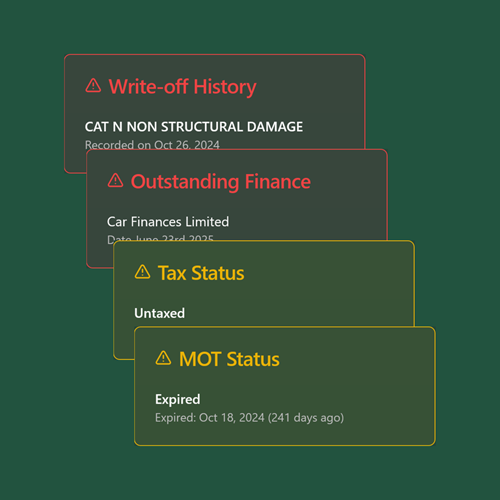
Limited Offer
Click the image below to apply the discount and continue to enter your REG plate.

What People Say
Your opinion matters
Trusted by People
- Accuracy Rate
- 99%
- Customer Rating
- 4.8/5
FAQ
What to expect from your car history check.
Latest Articles
Stay Informed with Our Expert Car Advice

Buying a Used Van for Towing: What Should You Check Before You Buy?
If your business needs to tow a trailer, transport machinery or move bulky equipment, choosing the right used van involves more than checking its engine, mileage and load space. You also need to know how much it can legally tow, whether it has enough capacity for your trailer and load, and whether the vehicle has been maintained well enough to handle the extra demands.

Buying a Used Van That Meets ULEZ and Clean Air Zone Rules: What to Check
Buying a used van can save you thousands compared with purchasing a new one. But if you regularly drive into London or other UK cities, there is another cost you need to consider before choosing a vehicle: emissions compliance. A van that looks like a bargain could become expensive to run if it does not meet the emissions standards for the areas where you work. Daily charges can add up quickly, particularly for tradespeople, couriers and small businesses that visit the same city several times a week.

Buying a Used Van for Your Business: How to Choose the Right Size
Choosing a used van for your business is not just about finding something affordable with enough room in the back. The size of the vehicle affects how much you can carry, how easy it is to drive, where you can park and how much you spend running it. Buy a van that is too small, and you may find yourself making extra trips or struggling to fit everything you need. Choose one that is unnecessarily large, and you could be paying more for fuel, tyres, maintenance and capacity you rarely use.

Buying a Used Van with High Mileage: What Should You Check?
A used van with 100,000 miles on the clock can look like a risky purchase. Find a similar van with 60,000 miles, and it is tempting to assume the lower-mileage option is automatically the better buy. But vans do not age in quite the same way as cars. Many spend their working lives covering long distances, carrying tools and materials, making deliveries or travelling between jobs. High mileage is part of commercial life, and it does not necessarily mean a van is close to the end of its useful life.